
Taj Mahal


The Taj Mahal (Mumtaj Palace) is India's most famous structure, and, perhaps the most beautiful piece of architecture in the world.  Photographs cannot truly capture its grandeur.  While this is true for most photos, it seems especially true for this almost perfectly proportioned tomb of Mumtaz Mahal and its creator, Shah Jahan, the fifth Mughal ruler
Mumtaz Mahal was the second, and favorite, wife of Shah Jahan (r. 1628-1658).  A Persian princess born as Arjuman Banu Begum, she was a significant influence in his life and in his policies.  She died at age thirty-nine while giving birth to their fourteenth (some say thirteenth) child in 1630. The ruler went into deep mourning and much of his empire was compelled to do the same.

You also like to read:- Best Time to Visit Taj Mahal
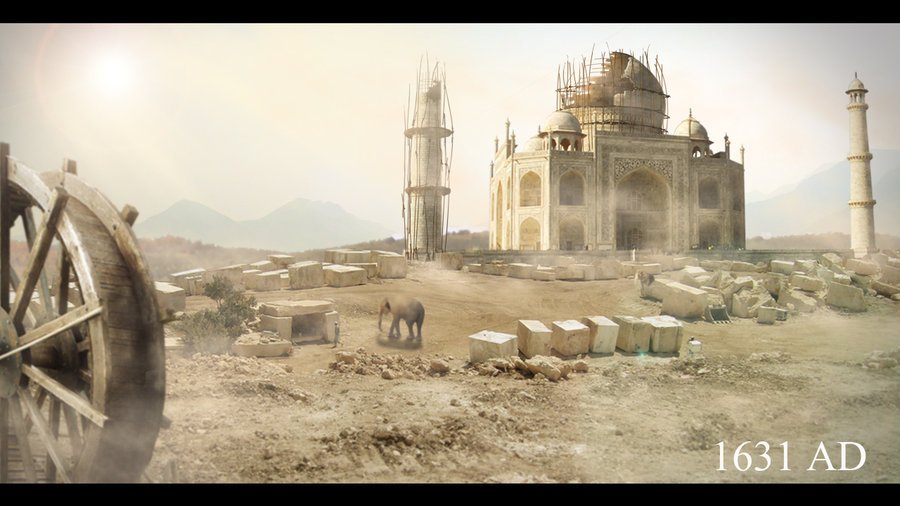


Almost immediately there was announced a competition for plans to construct a tomb and shrine worthy of the ruler's beloved.  Numerous legends surround the selection of the architect--some even implausibly suggesting that it was a westerner from Italy or France. But although a number of names have been proposed, the architect's name is unknown. It is clear that talent from many parts of the Muslim and western worlds came together in Agra to work on the mausoleum: engineers, carvers, artists, calligraphers, architects, craftsmen of all sorts, and a variety of common laborers.  It is estimated that 20,000 worked on the tomb from 1631 to 1648.  Work continued in the adjoining areas until 1653. It should be noted that the Taj Mahal is a total package of tombs, mosques, gardens, gateways, and fountains.  The workers did produce a grand masterpiece, but it, as well as wars and other projects, also strained the resources of the entire empire.

Shah Jahan moved his capital to Delhi from Agra in 1648.  There he built a number of new buildings, including the Delhi Red Fort that added further to the debt of the Mughal empire.  His serious illness of 1657, however, eventually brought familial conflict and a struggle for power; his son, Aurangzeb, seized the throne and imprisoned his father until the latter's death in 1666.


In the eighteenth century, external forces challenged the power of the Mughals, like Persians, French and British overturned the loosely-knit Mughal empire.  The Taj Mahal, accordingly, suffered from neglect and willful looting. Under the British, the marble terrace became a venue for balls and entertainments, and the gardens grew famous as trysting places.  The British treated the Mughal monuments with scorn, and in the late 1820s Lord William Bentinck, governor-general of Bengal even announced plans to strip them of the marble and send it to England for auction.  The Taj luckily was spared destruction because there had been no market for the marble already sent.

The Taj Mahal is set on a raised platform that is 6.6 meters (20 ft) high and covers an area of 93.9 sq. meters (313 sq ft). The corner minarets are 41.1 meters (137 ft) high.  The main structure is 62 meters (186 ft) on each side.  In contrast to the gleaming white marble of the mausoleum, there is a pair of red sandstone buildings flanking the tomb to the west and to the east; the western building is a mosque, while the other, sometimes called the guest house or museum, was built to complete the symmetry of the scene. The water causeway and fountains beautifully join the gateway and the tomb in perfect symmetry.
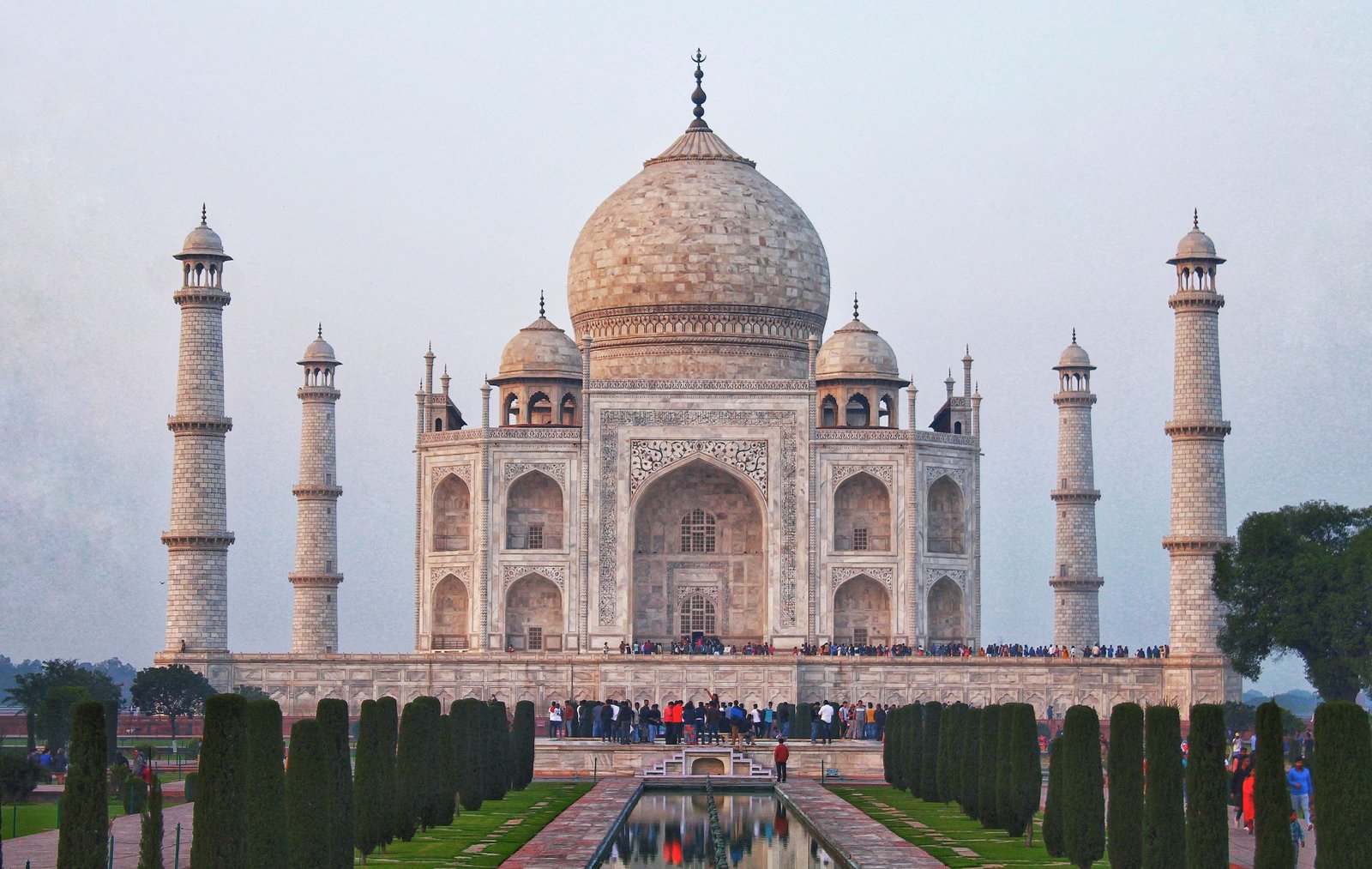


There are numerous significant and striking elements in the Taj Mahal. The marvelously graceful piedra dura (or stone inlay work) Adorns many surfaces.  This includes the three major elements of the Muslim decorative arts: the sayings from the Q'uran, geometrical shapes, and a variety of plant forms and flowers, often repeated as borders.  The marble and precious stone inlays are so skillfully fit together that one can hardly detect a seam, even with close examination. The calligraphy of sayings from the Q'uran on the mausoleum is in a kind of trompe l'oeil style;  the letters gradually increase in size as they go up the side of the structure so that from the ground all letters appear perfectly uniform.  Perhaps, however, the greatest impact is how all of its parts fit together so perfectly, making the entire complex much greater than the sum of its parts.


Finally, it is hoped that some solution will be found to deal with the enormous pollution of the area that is a threat to one of the world's supreme architectural achievements.

Taj Mahal Tours

Popular posts from this blog

Golden Triagle : Delhi, Agra And Jaipur

Fallow us     Twitter        Fallow us   Facebook North India attracts tourists and vacationists from all over the world. The region is full of tourist attractions and travel circuits. Golden triangle is one of the most preferred tourist circuits in northern India. This deserving travel circuit covers three major cities and tourist places of India. They are Delhi, Agra and Jaipur. New Delhi is the national capital of the Republic of India. It is perhaps the most visited tourist places in northern India. There are many good reasons to visit this historic and historical city. The city mesmerizes the world with its unique combination of ancient charm and modern world charm. It is home to three UNESCO world heritage sites - Red Fort, Humayun’s Tomb and Qutub Minar. Also kno wn as the Lal Quila, the Red Fort is one of the most opulent mughal monuments in the country. The Qutub Minar is the longest brick minaret in the world. Humayun’s Tomb is...

Mumtaj Mahal children were

Mumtaz Mahal was the focal accomplice of the Mughal head Shah Jahan. Anyway, Mumtaz's residency was short-lived, she had a brilliant master life as she had full oversight over Emperor Shah Jahan's decisions, so much that he would even vindicate foes and assuage capital disciplines at the ruler's intervention. Mumtaz impacted the issues of the state as she filled in as the sovereign's fundamental specialist. She was also Shah Jahan's trusted countryman and would routinely go with his escort, ignoring her progressive pregnancies. You also like to Read:- About Taj Mahal History Mumtaz's own life was one of happiness as she was the most unquestionable among the sovereign's life partners. Since Shah Jahan was absolutely blasted with Mumtaz Mahal, he contributed basically the aggregate of his energy with her, thoroughly ignoring his other two life partners at the same time. From now on, Mumtaz participated in the heavenliness of the Mughal Empire unbounded. In any...

Tourist destinations of India - Alamgir Khan, Taj Mahal Guide

       North India tour provides you a wonderful opportunity to explore some of top tourist destinations of India. There are many popular tourist destinations in northern India appealing tourists and vacationers from all over the world. Jaipur, Agra, Delhi, Varanasi, Kashmir, etc are popular tourist places in northern India. Jaipur - The Pink City of India Jaipur is one of the most popular tourist places of India appealing tourist through out the entire globe. Famously known as the Pink City of India it is the state capital of Rajasthan. There are a number of tourist attractions in this beautiful city. City Palace, Hawa Mahal and Jantar Mantar are icons or major landmarks of Jaipur city. City Palace is a beautiful palace complex housing many palatial palaces and terrific temples with gardens and courtyards. The terrific Govind Devji Temple is located inside the City Palace Complex. Laxmi Narayan Temple, Swami Narayan Temple, Moti Dungri, Albert Hall Museum, Am...

Decoration Of Taj Mahal -Alamgir Khan Agra

Fallow us     Twitter        Fallow us   Facebook                        The exterior decorations of the Taj Mahal are among the finest in Mughal architecture. As the surface area changes the decorations are refined proportionally. The deco rative elements were created by applying paint, stucco, stone inlays, or carvings. In line with the Islamic prohibition against the use of anthropomorphic forms, the decorative elements can be grouped into either calligraphy, abstract forms or vegetative motifs. All beautyful inlay work in Taj mahal is noteble' Craftsmen use simple peice of stone ( Zems) and created into followers,stems,leaves and buds. set io marble and fix it. Callig raphy The calligraphy was created by a calligrapher named Abd ul-Haq, in 1609. Shah Jahan conferred the title of "Amanat Khan" upon him as a reward for his "dazzling virtuosity". Near the lines from the Qur'a...