
Shah Jahan and Mumtaz Mahal
Shah Jahan was the fifth Mughal emperor and is closely associated with some of the most ambitious architectural projects of the Mughal period.
Mumtaz Mahal, whose name was Arjumand Banu Begum, was Shah Jahan's wife and an important figure in the imperial household.
The Taj Mahal was conceived as a monumental memorial rather than simply a palace.
Its architecture communicates ideas of permanence, order and beauty through its carefully balanced composition.
When Was the Taj Mahal Built?
The construction history of the Taj Mahal is sometimes simplified online, so it is useful to distinguish between the main mausoleum and the wider complex.
UNESCO states that construction of the Taj Mahal began in 1632 and that the principal mausoleum was completed in 1648. The mosque, guest house, main gateway and other parts of the complex were completed subsequently, with the wider complex reaching completion around 1653.
This explains why different sources sometimes give slightly different completion dates.
Rather than thinking of the Taj Mahal as a single building completed on one day, it is more accurate to understand it as a carefully planned architectural complex developed over several years.
Taj Mahal Architecture
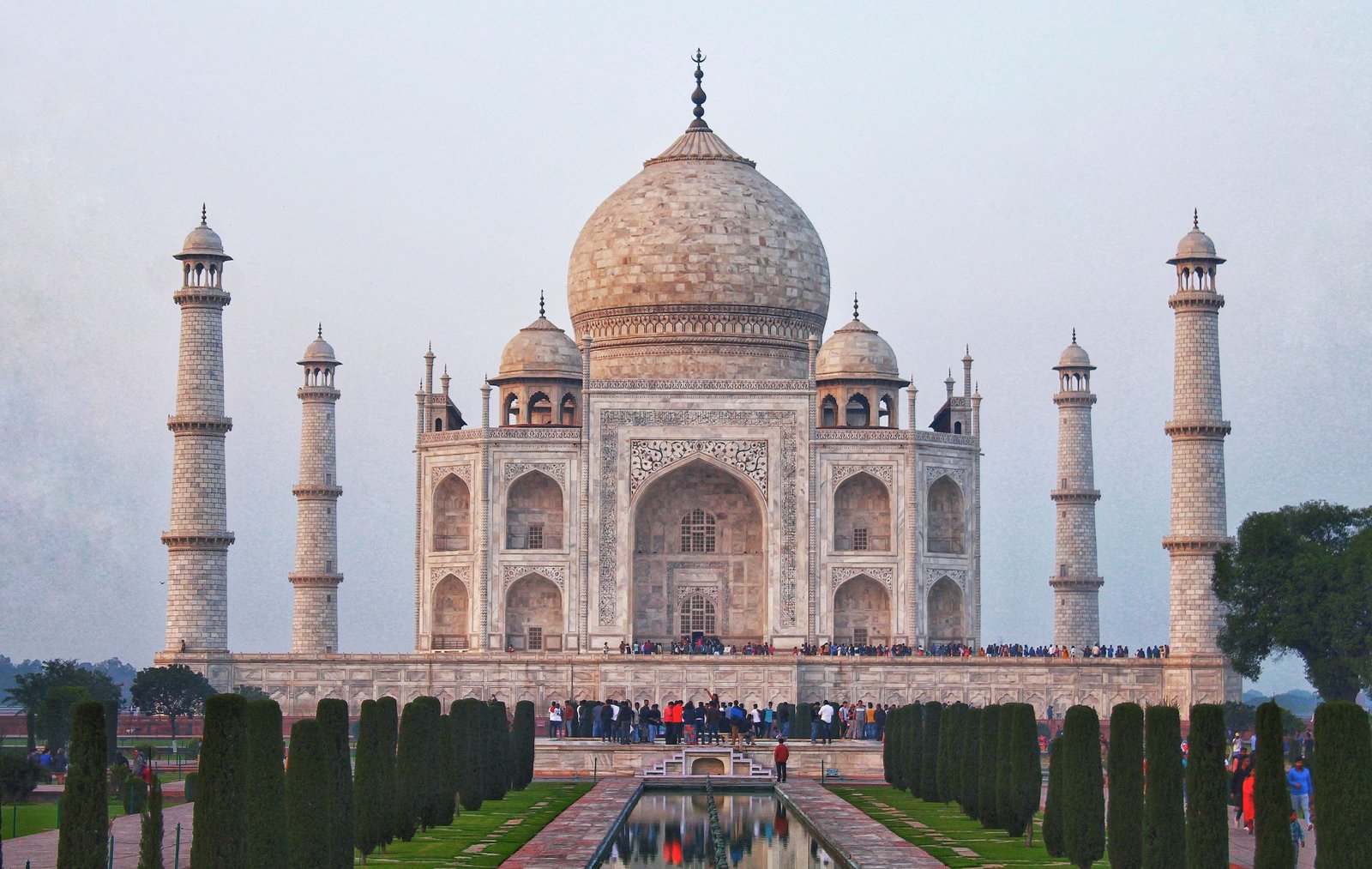
The Taj Mahal is celebrated for its extraordinary balance and symmetry.
The main tomb stands on a raised platform with four minarets at its corners. The central structure includes a large domed chamber surrounded by additional architectural spaces.
UNESCO highlights the monument's rhythmic combination of solids and voids, arches and domes, light and shadow, as well as its overall balance and symmetry.
The design reflects several architectural traditions associated with the Mughal world, including influences from Persian, Central Asian and Indian building traditions.
The White Marble of the Taj Mahal
White marble is one of the defining visual characteristics of the Taj Mahal.
The central mausoleum is faced with white marble, while other parts of the complex use contrasting materials, including red sandstone.
The changing appearance of the marble is one reason the monument can look different under different lighting conditions.
Morning light, afternoon sunlight and softer evening conditions can produce noticeably different impressions of the same architecture.
The contrast between white marble, the gardens, pathways and surrounding sky also contributes to the visual effect described by UNESCO.
Pietra Dura and Stone Inlay
One of the most remarkable features of the Taj Mahal is its decorative stone inlay, often associated with the pietra dura tradition.
Craftspeople inserted carefully shaped pieces of colored stones into the marble to create floral and decorative patterns.
The work required exceptional precision.
Instead of relying only on painted decoration, artisans created permanent patterns by cutting and fitting different materials into the marble surface.
UNESCO specifically identifies the Taj Mahal's marble relief work and inlay using precious and semi-precious stones as important elements of its artistic significance.
Taj Mahal Calligraphy
Look closely at the gateways, arches and marble surfaces of the Taj Mahal and you will find another important artistic tradition: Arabic calligraphy.
Quranic inscriptions form an integral part of the monument's visual program.
The inscriptions are not simply decoration added to an otherwise complete building. They were incorporated into the architecture itself, becoming part of the relationship between text, proportion and space.
UNESCO notes that historical and Quranic inscriptions in Arabic script have also helped researchers establish chronology within the Taj Mahal complex.
Amanat Khan Shirazi and the Calligraphic Tradition
Amanat Khan Shirazi is traditionally identified with the calligraphic work of the Taj Mahal.
His name is particularly associated with the Quranic inscriptions on the monument.
When discussing the calligraphy, it is important to distinguish the role of the calligrapher from that of the architect, builders and other craftsmen. The Taj Mahal was a collaborative imperial project involving specialists in different fields.
UNESCO describes artisans involved in the complex as including masons, stone-cutters, inlayers, carvers, painters, calligraphers and dome builders, with skilled workers brought from across the Mughal Empire and from regions including Central Asia and Iran.
Thuluth Script and the Taj Mahal
The calligraphy of the Taj Mahal is associated with the Thuluth tradition of Arabic script.
Thuluth is known for its elegant, elongated forms and has historically been used for monumental architectural inscriptions.
At the Taj Mahal, calligraphy works together with the architecture rather than appearing as an isolated art form.
The lettering follows architectural surfaces and contributes to the visual rhythm of arches, gateways and panels.
This relationship between text and architecture is one of the details that becomes easier to appreciate when the Taj Mahal is viewed in person.

Why Do the Calligraphic Letters Look Larger at the Top?
One fascinating feature of the Taj Mahal's inscriptions is their apparent consistency in size when viewed from the ground.
The monument uses visual techniques to compensate for perspective.
Letters placed higher on architectural surfaces can be made larger so that they appear more uniform to an observer standing below.
This is an example of how Mughal craftsmen considered not only decoration but also the viewer's experience.
The result is an inscription that looks more balanced from the intended viewing position.
The Taj Mahal's Symmetry
Symmetry is one of the defining characteristics of the Taj Mahal.
The main architectural elements are organized around a strong central axis.
The four minarets frame the central mausoleum, while the surrounding complex follows carefully planned relationships between buildings, gardens, pathways and water features.
UNESCO describes the Taj Mahal as a perfectly balanced composition with strong bilateral symmetry along its central axis.
However, there is one fascinating exception.
After Shah Jahan's death, his cenotaph was placed beside Mumtaz Mahal's rather than directly opposite it, disturbing the perfect symmetry of the central tomb chamber.
This is one of the most interesting details to notice when studying the interior.
The Four Minarets
Four slender minarets stand at the corners of the main platform.
They provide a strong visual frame around the central mausoleum and contribute to the monument's three-dimensional appearance.
UNESCO identifies the four free-standing minarets as an important architectural innovation within the Mughal tradition represented by the Taj Mahal.
Their placement also reinforces the sense of balance that defines the entire composition.
The Taj Mahal Gardens
The Taj Mahal complex includes a large Mughal garden based on the charbagh tradition.
The garden is organized geometrically, with pathways and water channels dividing the space into sections.
The relationship between garden, water, sky and marble architecture creates the famous long perspective toward the mausoleum.
Interestingly, the main tomb is positioned at the northern end of the garden rather than in its exact center.
UNESCO identifies this arrangement as one of the distinctive planning features of the Taj Mahal complex.
.png)
The Mosque and Guest House
The Taj Mahal complex includes two important red-sandstone buildings on either side of the main mausoleum.
One is a mosque and the other is a guest house.
Their similar appearance contributes to the visual balance of the complex.
The contrast between the red sandstone buildings and the white marble mausoleum also strengthens the overall composition.
UNESCO notes that the mosque and guest house are substantially similar structures and form part of the carefully balanced architectural plan.
The Main Gateway
Before reaching the mausoleum, visitors pass through the monumental main gateway.
The gateway creates a transition between the outer area and the formal garden.
Its scale, arches, decorative work and inscriptions prepare the visitor visually for the monument beyond.
This sequence is important.
The Taj Mahal was not designed simply as an isolated building. The experience develops gradually through gateways, garden perspectives, water features and architectural framing.
What Materials Were Used at the Taj Mahal?
The Taj Mahal is famous for its white marble, but the complex uses several materials.
Important materials include:
- White marble
- Red sandstone
- Brick and lime mortar
- Precious and semi-precious stones for inlay
- Marble for carved and lattice elements
The decorative surfaces demonstrate how different materials were combined to create contrast, texture and color.
UNESCO identifies brick-and-lime construction with marble and red-sandstone facing, together with precious and semi-precious stone inlay, as part of the monument's material character.
The Craftsmanship Behind the Taj Mahal
The Taj Mahal could not have been created by one architect or one group of craftsmen.
It was the result of a large collaborative effort.
Different specialists contributed to different parts of the complex, including:
- Architects
- Masons
- Stone-cutters
- Inlay specialists
- Carvers
- Painters
- Calligraphers
- Dome builders
- Garden planners
UNESCO records that craftsmen were brought from throughout the Mughal Empire and from Central Asia and Iran.
This is one reason the Taj Mahal should be understood as a masterpiece of collective craftsmanship, rather than simply the work of a single individual.
.jpg)
Who Designed the Taj Mahal?
Historical discussions about the Taj Mahal sometimes reduce its design to one name.
UNESCO identifies Ustad-Ahmad Lahori as the main architect of the Taj Mahal.
At the same time, the monument was a collaborative imperial project involving many specialists.
Therefore, it is more accurate to discuss the Taj Mahal through its wider network of architects, craftsmen, calligraphers, engineers and planners rather than suggesting that one person created every detail.
Taj Mahal Myths vs. Historical Evidence
The Taj Mahal has inspired many stories over the centuries.
Some are repeated so frequently that they can sound like established history.
One example is the popular story of a “Black Taj Mahal” that Shah Jahan supposedly planned to build across the Yamuna River as his own matching mausoleum.
The story is fascinating, but it should be presented as a historical theory or legend rather than an established fact.
The same approach should be used for claims about secret rooms, the identities of every craftsman, or dramatic stories about the monument's construction.
A good travel article should distinguish between:
Documented history
Scholarly interpretation
Popular legend
This makes the information more trustworthy for international readers.
The Taj Mahal as a UNESCO World Heritage Site
The Taj Mahal was inscribed on the UNESCO World Heritage List in 1983 under cultural criterion (i).
UNESCO recognizes it for its exceptional architectural and artistic achievement and its importance within Indo-Islamic architecture.
The monument is therefore important not only to India's cultural heritage but also to the world's architectural heritage.
Why the Taj Mahal Still Fascinates Travelers
Photographs can show the Taj Mahal's appearance, but they cannot fully communicate the experience of standing in front of the monument.
Visitors can observe details that are easy to miss in photographs:
- Fine marble carving
- Stone inlay
- Arabic calligraphy
- Geometric patterns
- Marble lattice screens
- Architectural symmetry
- Reflections in water
- The relationship between garden and monument
The closer you look, the more complicated the building becomes.
From a distance, the Taj Mahal appears remarkably simple.
Up close, it reveals layers of craftsmanship.
Visiting the Taj Mahal from Delhi
For international travelers staying in Delhi, Agra can be visited as a day trip or as part of a longer northern India itinerary.
A private car, train or other transportation option can be considered depending on your schedule and travel preferences.
If you are planning a same-day visit, read this Taj Mahal day trip from Delhi guide for practical planning information.
If you are deciding when to travel, our best time to visit the Taj Mahal guide can help you compare seasons, weather and sightseeing conditions.
And if you are staying in Delhi and want to understand the transportation choices before visiting Agra, see our guide to reaching Agra from Delhi.
Exploring Agra Beyond the Taj Mahal
The Taj Mahal is only one part of Agra's heritage.
Visitors can also explore:
- Agra Fort
- Itmad-ud-Daulah's Tomb
- Mehtab Bagh
- Mughal-era architecture
- Local crafts and marble inlay
- Traditional markets and food
Spending more time in Agra can provide a deeper understanding of the historical environment in which the Taj Mahal was created.
Final Thoughts
The Taj Mahal is often described simply as a monument of love.
That description captures part of its emotional appeal, but the building is much more complex.
It is simultaneously a Mughal imperial mausoleum, architectural masterpiece, garden complex, center of calligraphic art and extraordinary example of craftsmanship.
Shah Jahan commissioned the monument in memory of Mumtaz Mahal, but generations of architects, craftsmen, calligraphers, stone-cutters and other specialists transformed that commission into the extraordinary complex visitors see today.
Look beyond the famous photograph and you will find another Taj Mahal: one of marble, mathematics, calligraphy, craftsmanship and carefully planned space.
That is what makes a visit to Agra more than simply seeing a monument.
It is an opportunity to experience one of the world's great architectural achievements in person.
Comments
Post a Comment